Kathy becomes Tommy’s carer
Never Let Me GoKathy becoming Tommy’s carer marks the passage from a long separation into a new period of daily closeness. The decision grows out of her promise to Ruth, but it also draws on Kathy’s established practice of choosing donors with whom she shares a past: care becomes both a professional responsibility and a way to recover relationships formed at Hailsham.
Background and Choice
Kathy is already an experienced carer when the possibility of looking after Tommy arises. At thirty-one, she has worked for more than eleven years and expects to continue until the end of the year, bringing her tenure to almost twelve. She describes care as work that can wear down a person’s patience and energy, and says that choosing donors became possible only during the last six years of her service. She does not present this preference as proof of superior skill; rather, she sees familiarity as a source of the emotional connection that helps her continue caring well.
That preference is rooted in her history with Ruth and Tommy. Ruth was only the third or fourth donor Kathy chose, and Kathy had to summon some nerve to arrange the change because Ruth already had a carer. Their differences did not disappear when they met again at the Dover recovery centre, but their shared Hailsham past gave them memories and knowledge they could not share with others. Kathy consequently began seeking donors from her past, especially people from Hailsham. Becoming Tommy’s carer extends that practice to a relationship whose significance precedes the assignment itself.
Ruth’s Request and Kathy’s Promise
The decision takes shape through Ruth’s effort to bring Kathy and Tommy together. Ruth repeatedly raises the possibility of Kathy becoming Tommy’s carer, and Kathy answers that arranging it is not simple. The idea comes to stand for what Ruth wants beyond the practical reassignment: a renewed connection between the two people she has known since Hailsham. At their final meeting, Kathy understands Ruth’s unspoken wish even though Ruth can no longer speak.
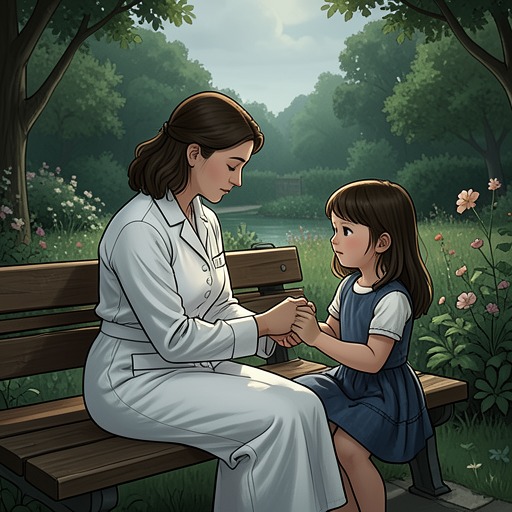
That meeting takes place three days after Ruth’s second donation. Kathy finds her alone in a hospital room, still conscious but largely inaccessible as pain absorbs her attention. She sits beside the metal bed, holds Ruth’s hand in both of hers, and stays as long as she is allowed—three hours, perhaps longer—squeezing Ruth’s hand when pain makes her twist away. During a brief interval of lucidity, Ruth looks directly at Kathy. Kathy answers that she will become Tommy’s carer as soon as she can, hoping Ruth will understand her expression as clearly as Kathy has understood Ruth’s. Kathy cannot know for certain whether the message reaches her, but later considers that Ruth may have understood the plan before Kathy herself did.
The Transition at Kingsfield
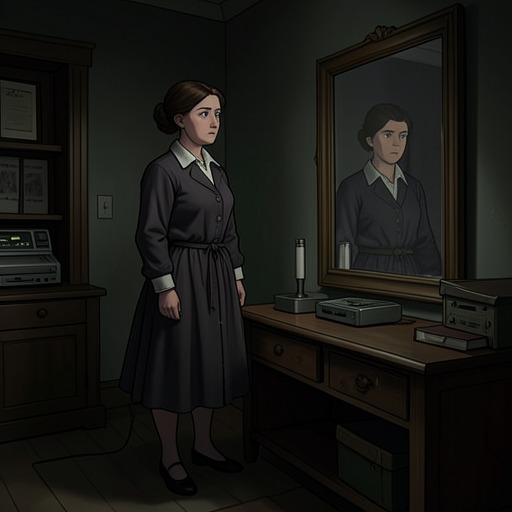
Kathy becomes Tommy’s carer almost a year to the day after the trip to see the stranded boat. The reassignment comes not long after Tommy’s third donation. He is recovering well but still needs substantial rest, which gives them a quiet beginning to their new phase together at Kingsfield. Kathy gradually grows accustomed to the centre and even comes to like it.
Their routine is unhurried. Kathy usually arrives after lunch to find Tommy stretched out on his narrow bed, fully clothed because he does not want to feel like a patient. She reads aloud from paperbacks, including The Odyssey and One Thousand and One Nights, or they talk about Hailsham and other subjects. When Tommy dozes in the late afternoon, Kathy catches up on reports at the small school desk in his room. The familiarity of these ordinary visits makes the years between them seem to melt away: the formal carer-donor arrangement supports an ease that is also personal.
Care, Time, and Their Shared Future
The new closeness does not remove the unequal burdens built into their circumstances. Kathy has spent years caring for donors while remaining a carer herself; Tommy, like the others, faces successive donations. After he receives notice of his fourth donation, they discuss how donors respond to that milestone and why it inspires such anxiety. Tommy raises the fear that no one can be sure what completion means or whether further donations might follow it. Kathy dismisses the speculation, but recognizes that she has no evidence to reassure him, and that the conversation closes off a fear they had begun to share.
Tommy later asks whether Kathy ever tires of being a carer and wishes that her own notice would arrive. The question exposes the distance between her role and the donors’ fate, even within their intimacy: Kathy can offer skilled, sustained care, but she is not undergoing the same process. Her becoming Tommy’s carer therefore answers Ruth’s request while placing Kathy beside Tommy through a period shaped by recovery, dependence, and uncertainty. It makes their shared past present in daily acts of reading, listening, and staying with one another.